An overview and introduction to the FIBO Data Model and its application as an Open Banking accelerator.
This presentation was for an overview meeting with a large European bank. I replaced the bank’s logo and name with a generic one.
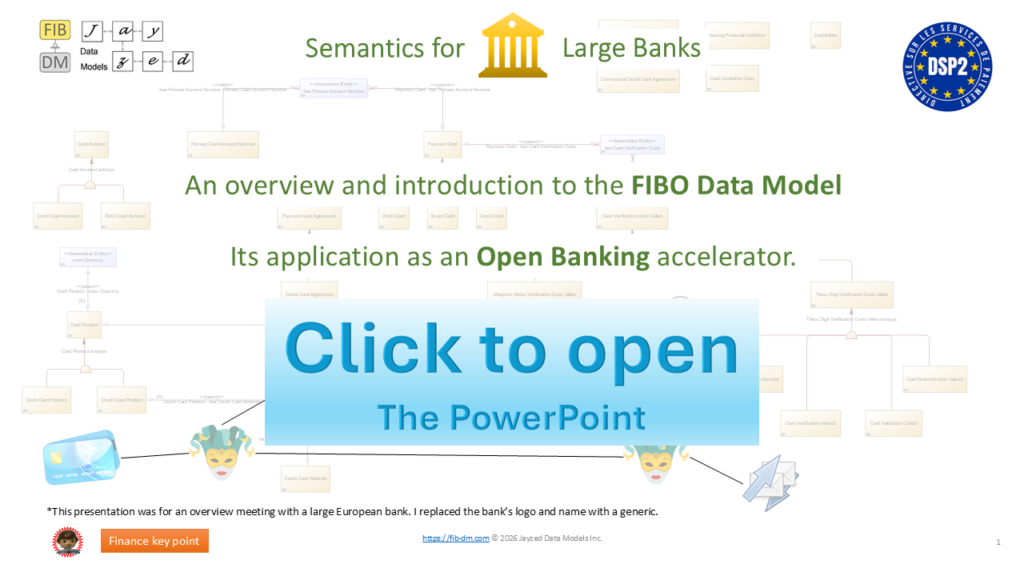
You can watch the video and download a PDF version of the presentation.
Text of the presentation
Semantics for Large Banks
An overview and introduction to the FIBO Data Model
Its application as an Open Banking accelerator.
*This presentation was for an overview meeting with a large European bank. I replaced the bank’s logo and name with a generic.
F Finance key point 1
https://fib-dm.com
FIBO is the authoritative model concepts, their definitions, and
of Financial Industry relations.
The Enterprise Data Management Council (EDMC) is the Global Association of over 200 Financial Institutions (FI).
- Data Management best practices
- Development and implementation of Data Standards.
EDMC members developed the Financial Industry Business Ontology (FIBO), a business conceptual model.
2435 classes detail counterparties, transactions including payments.
F Finance key point 2
FIBO is a business model and a schema
“The Financial Industry Business Ontology (FIBO) is a business conceptual model developed by our members of how all financial instruments, business entities, and processes work in the financial industry.” (EDMC)
The council specifies the model in Resource Description Framework Schema and Ontology Web Language, RDF/OWL.
The ontology enables you to specify sample data values and complex constraints beyond the Conceptual Data Model.
F Finance key point 3
There is a chasm between semantic conventional data management.
The EDMC specified FIBO in Ontology Web Language (OWL).
FIBO is comprehensive with detailed coverage of business entities, loans, securities, derivatives, and indicators.
Large financial institutions started implementations on RDF (“triple”) stores
and
OWL needs highly specialized ontologists.
Many banks and investment managers don’t have the expertise inhouse.
IT-departments must still support and design conventional databases.
Data Architect 4
ELB current state challenges
- Thousands of Silo database systems with millions of tables • Duplicate, 30+ “Master” systems for customers & products • Data Architecture trapped in operational support
- “Validating” operational schemas – no integration
- Lack of management buy-in for logical reference models
Poor Data Management Capabilities impede competitiveness, innovation, and regulatory compliance.
F Finance key point 5
FIB-DM is the bridge across the chasm.
in
The Industry Standard is available in your Data Modeling tool.
F Finance key point 6
FIBO and FIB-DM are the Industry Standard
The Enterprise Data Management Council endorses the FIBO Data Model on its website
Three thousand five hundred users and 162 banks downloaded the Open-Source core version.
ELB Data Architecture team downloads the PowerDesigner model.
F Finance key point 7
Semantic Enterprise Information Architecture
Use Type FIB-CM RDF FIBO OWL Level
Business Conceptual
FIB-DM
FIB-UM Enterprise
Design Logical
Data Model
Department
Physical
Development RDBMS
Implementation
RDF Project
Data Message Process Object
Open Banking needs data, object, and message models!
F Finance key point 8
Path for ELB
Immediate ROI using the FIBO content and design patterns from day one.
2025, adopt the Industry Standard, FIBO data and concept model
2026, train data architects in OWL. Customize FIBO to become your Enterprise Ontology
2027, Semantic Enterprise Information Architecture
Easy to learn a new language, OWL, and tooling, if you already know content and design.
F Finance key point 9
Financial Industry Business Data Model
= in
(and other data modeling tools)
- Financial Industry Business Data Model of 3,173 Entities, complete definitions, annotations, and axioms (business rules).
- Data Architects leverage the full content of the Industry Standard.
- Common Language and design patterns for Semantic & Relational data.
F Finance key point 10
The ontology transformed into a data model leverages the design for relational databases.
FIBO RDF OWL
FIB-DM Data Model
Configurable Ontology to Data-model Transformation
Semantic Triple Store Relational Database
The RDF-Store is for knowledge and analytics – not for transaction processing, core banking
F Finance key point https://fib-dm.coms:/© Jayzed Data Models Inc. 2019 Models Inc. 11
http /fib-dm.com © 2026 Jayzed Data
Atlantic is the way to Semantic EIA and MDD
2025/Q4
Full
release
3,173 entities
The world’s largest data model.
Configurable Ontology to Data model Transformation (CODT)
F Finance key point 12
The 15 concept mnemonic icons, and abbreviations
SIT Situation
A Agent
R D Role Designation
ASP SP Aspect Specification
CST Constituent
ARR Arrangement
COL Collection
M Measure
The Fundamental concepts define the Open Banking scope: Registry (ARR), Network locations (LOC), new products and services, customer agreements, documents, accounts, an of course the API request (OCC) and their timestamps (TI).
The concepts are ultimate supertypes in the data model.
OCC Occurrence
TE Temporal Entity
DOC Document
SQ Scalar Quantity
ACT Account
F Finance kuesyerpoint 13
Open Banking example
European Union: Revised Payment Services Directive, PSD2
The standard PSD2 diagram shows the four actors and their relations.
National Competent Authority
certifies enrolls
In the FIBO, they are a Role.
The FIB concept maps use the mask as a symbol.
uses Requests payment
Payment Service User
Third Party Provider
validates
Account Servicing/ Payment Service Provider
Data Architect 14
Expanding the scope
identifies
Photo ID number
All Things in Role have an identity, the Agent.
Person
Has Identity
Bank Itau
ELB
The payment user is a Person. The Photo ID, a Reference, identifies her.
uses
Requests payment
Third Party Provider
Account Servicing/ Payment Service Provider
An Autonomous Agent can have many roles.
It may also be a third-party provider requesting information from another bank.
Data Architect 15
The concepts and vocabulary establish a direct correspondence between the map and the data model.
Legal Entity
Identifier
Monetary has Issued Capital Amount
Country
has Country
has Legal Address
Stock Corporation
Plays Role
Physical Address
Registration registers Authority
Depository Institution
Is registered In
FDIC Certificate Number
FDIC Registry Entry
F Finance key point 16
Transparency for your FIB-DM evaluation
Explore the PowerDesigner Model
Semantics for Data Architects Study the Education resources
Examine the 2025/Q4 Full Model content
Review license, maintenance, and pricing
F Finance key point 17
Thanks,
and enjoy ELB the ride
Semantics for Finance Users explains the 15 fundamental concepts for non-technical audiences.
Scoping our first data model transforms a concept map to PowerDesigner and creates a project model.
https://www.youtube.com/c/fibdm https://fib-dm.com/
Data Architect 18