The galleries present the concept and package diagrams of the Financial Industry Business Data Model. FIBO ontology modules transform into FIB-DM packages. In other words, the data model entities, attributes, and relationships in a package all share the same code prefix. Concept diagrams show business content in a context,
FIB-DM Base Packages
The diagram shows the FIB-DM base packages with connectors representing the main dependencies. You can hover over a package to see the link, and click on it to open the diagram page. Right-click on other areas to open the SVG file in a separate tab.
Grey: The FIBO includes upper ontologies from the Object Management Group (OMG) and World Wide Web Consortium (W3C).
Green: Foundation, Business Entities, and Finance, Business & Commerce are the Core FIBO ontology modules.
Blue: New specialized packages for Banking and Processes derived from the recent FIBO modules.
Orange: Investment and Capital Market-related content for Securities and Derivative instruments.
Packages
ER diagram convention
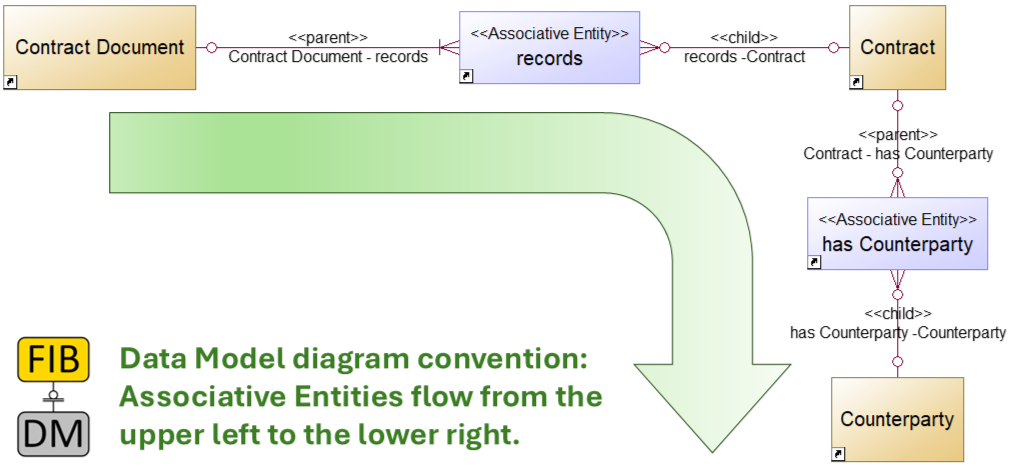
Entity-Relationship diagrams are easy to read because they follow a consistent style and convention: Base Entities are derived from FIBO/OMG classes and are shown in ochre. Associative Entities (in blue) connect them. Data model relationships connecting Base to Associative Entities have a stereotype, <<parent>> or <<child>>. In the diagram snippet, the data modeler reads, “The Contract Document (parent) records the Contract (child).
Associative entities flow from the upper-left corner of a diagram to the lower-right corner. Similar to the flow of a foreign key, the logical or physical modeler may replace the Associative entity with a direct relationship between the entities.
From a Base Entity, we navigate right and down to find Associations where the Base Entity is the parent. We look up and to the left to find Associations where it participates as the child.
Likewise, from an Associative Entity, we navigate left or up to find the parent Base entities, and down and right to find the children.
Because of this diagram convention, reference entities tend to end up in the upper-left corner, and high-volume entities like accounts or transactions end up in the lower-right corner of a FIB-DM diagram.
ERWin Diagrams
The FIBO Data Model is moving to ERWin DM. Most of the over 90 package diagrams are still in PowerDesigner format. During the transition, from now to the end of 2027, we publish new diagrams exclusively in ERWin, and we will replace PowerDesigner diagrams for FIBO modules with substantial changes.
The Gallery is for interested ERWin data modelers and modelers replacing PowerDesigner. New ERWin diagrams are also in the galleries below, gradually replacing their PowerDesigner predecessors.
OMG Commons
Derived from the upper ontology, subpackages provide the FIB-DM/FIBO Fundamental Concepts, ultimate supertypes for 90% of entities in the data model: codes, classifiers, dates & times, designators (IDs), organization, parties & situations (contracts), roles, collections
Foundation
The foundation data model package includes generic design patterns such as dates and times, virtual and physical places, agents and parties, agreements, and arrangements.
Finance Business & Commerce
The Finance, Business & Commerce package extends Foundation with Financial Instruments, Products and Services, Financial entities, Clients & Accounts, and Equity and Debt
Business Entities
The Business Entities package defines legal entities and organizational units.
ACTUS
ACTUS (Algorithmic Contract Types Unified Standards) is a global financial standard that provides a machine-readable, algorithmic representation of financial contracts. Three packages represent the ACTUS Contract Terms, Taxonomy, and a Mapping to the FIBO.
Loans & Mortgages
The Loans Package diagram displays all objects derived from the FIBO Production Loans ontology files.
Securities
The Securities gallery shows the Securities package diagrams of the Financial Industry Business Data Model.
Derivatives
The Derivative Contracts package covers the fundamentals of forwards, options, swaps, and contracts on Commodities and Currencies.
Specialized packages for Rates, Securities, and Credit Derivatives inherit from Contracts.
Indicators & Indices
The diagrams in the gallery depict package entities for economic and financial indicators, indices, foreign exchange, and interest rates.
Corporate Actions and Events (CAE)
The FIBO CAE ontology provides a hierarchy of 20 “Action” subclasses, which are transformed into entities in the data model package.
Open-source version diagrams (archive)
These older diagrams of Foundation, Business Entities, and Finance Business & Commerce are pre-OMG Commons applicable to the FIB-DM Core, open-source version.
FIB-CM
Concept Associations
The standardized FIB-CM (Financial Industry Business Concept Maps) uses 15 icons and acronyms. For every concept, the Gallery has a diagram of its most significant associations with other concepts.
The “Semantics for Finance Users” class teaches the 15 Fundamental Concepts and their associations in detail, using the diagrams in this gallery.