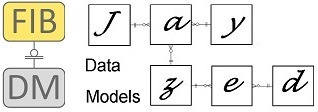
An introduction to the ontology-derived Enterprise Data Model for Finance and Business stakeholders.
FIB-DM is enormous, with 3,173 normative entities as of January 2026, and still growing. The Fundamental Concepts are the key to understanding the design and content. This education module provides an overview of the fifteen concepts.
A reference sheet for each concept shows:
- FIBO definition
- Concept hierarchy
- Significant associations
You can read the presentation or review the Presentation here.
Transcript of the Lecture
Welcome back to the Financial Industry Business Data Model education course.
My name is Jurgen, and I’m teaching this class: Semantics for Business Users – FIBO/FIB-DM fundamental concepts.
The video is a retake based on the 2026 courseware, which reflects OMG Commons and FIBO Loans.
Understanding the model, scoping, and designing with business users
FIB-DM is enormous. It has over 3,000 entities derived from FIBO Q4 2025, and the Fundamental Concepts are the key to understanding the design and content of the FIBO Data Model. Concept maps are a tool for data modelers and ontologists to communicate and refine their design with business users.
The Object Management Group’s Commons Ontology Library defines most Concepts and the FIBO imports OMG Commons. All Fundamental Concepts are ultimate supertypes in the FIBO Data Model.
This introduction is for non-technical audiences. It provides an overview of the 15 Concepts, their definitions, hierarchy, and most important associations.
The Fundamental Concepts are for all audiences. This is quite a deep dive, but it doesn’t require knowledge or expertise in data modeling or ontology tools.
For Finance users and Subject Matter Experts: you already know Concept Maps and will find it easy to understand the 15 Concepts, along with their icons and charts, which are meant for Business users.
As a data architect or modeler, you work with business clients and want to use Concept Maps for reviews and joint design. The 15 Concepts are the key to understanding the FIBO Data Model.
And likewise, as an ontologist, you can use the very same FIB Concepts to understand scope and customize the FIBO. Just like the DA, you can use concept maps rather than complex graphs to work with the Business.
So, how do the Concepts fit into Semantic Enterprise Information Architecture?
If you recall, we can look at the IT landscape, and we can classify artifacts by their use, whether it’s for business design, development, the type, whether it’s conceptual, logical, physical, or implementation, and the level: enterprise, department, or projects.
What we are all familiar with are data models deployed on RDBMS.
And we have other artifacts. We have XSD, process models, and class models, all of which are instantiated.
What is new is the FIBO in RDF/OWL. Ontologies are deployed on RDF stores.
And with FIB-DM, we use FIBO as the Conceptual Data Model, from which we generate logical data models and deploy them to relational databases.
Likewise, we can generate other models, such as class models, from the FIBO. And now here are the Concept Maps. They align with the ontology and align with the data model.
Learning FIB-DM is a two-pronged approach and is the key to understanding the industry standard.
For Enterprise Architecture, we focus on the hierarchies of the 15 Concepts and Associative Entities.
For Solution Architecture and Projects, we focus on FIB-DM packages and FIBO modules. However, even if we don’t need the whole model, it is important for project modelers to understand the Concepts so that they can understand how the packages are designed.
FIB Concept Maps have an agreed vocabulary. You are probably already familiar with concept maps in general. It’s a simple diagram that shows relationships between concepts. So, here we have a bank that may have an FDIC certificate with a global identifier, issued capital, an address, and so on.
Now, the FIB-CM has replaced the generic circles with standardized icons for concepts and an Agreed Vocabulary for the labels.
Okay. Here, the bank is a role, and the certificate is an ID. These icons recur throughout the Concept Maps that you design. Likewise, as we will see, the arrows here play a role in identifying and registering, which is also from an agreed-upon vocabulary of the Associative Entities in FIB-DM.
The Concept Maps and Vocabulary establish a direct correspondence between the map and the data model. On the left-hand side, we have our Concept Map, and we can then use the concepts to scope their counterparts in FIB-DM.
So, there are 15 concepts. They all have an icon, a shorthand, and a name.
And each concept is an in-depth business taxonomy. Now, for example, the Situation concept has over 1,000 classification items
You probably use Excel workbooks or other representations and visualizations to research taxonomies. You can identify items that fit the business requirements, but do not create synonyms. Work with your data or business architect to extend the taxonomy as needed. In other words, if we add to the taxonomy, we should also add to the FIBO Data Model and to the ontology.
The FIB-DM relationships derive from the vocabulary of more than 755 standardized names. We can search for a matching association, like here, for example, we look at “has Issued Capital,” and we can use the Navigator to investigate the parent and child entities and the concept.
So here we have our “has Issued Capital,” the parent concepts, the child entity, and the Monetary Amount. And with that, we find the Concept Map. Okay, it’s the concept of Agent, and we label it as a Stock Corporation.
The relationship is “has Issued Capital,” and the Capital is a Monetary Amount, which falls under the FIB concept of a Scalar Quantity
And then we can complete the conformed Concept Map. We can use MS Visio templates with the FIP Concept stencils, or any other Concept Map diagramming tool. Well, some modelers create a custom model and map it to the FIB-DM conceptual data model. So, who does this? It can be a Business Analyst, Data Modeler, or user. It depends on your organization and the people on the project.
The 15 concept that taxonomies and relationships capture 90% of the business and data requirements, and the high-level design.
The Data Model and Concept Maps: I told you that there’s a direct correspondence between the FIB Concept map and the Data Model. Semantic Enterprise Information Architecture considers the FIB-CM as a simplified notation in sync with the data model. Just as we derive a physical data model from a logical model, we can derive a conceptual data model from a concept map, and we should reflect changes in the CDM in the concept map.
The controlled vocabulary of FIB-CM consists of the FIB-DM Base and Associative Entities. The Excel Navigator workbook is derived from the data model reports.
Let’s look at the depth of the concept hierarchies. So the table here is a pivot of the number of subtypes under the Ultimate Supertype. We see the Situation concept here, a mega concept with over a thousand subtypes, and then Designation, Constituent, and so on. We see how many entities are underneath that concept. The number of Concept Associations. In other words, the arrows in the concept maps. The table shows the number of Associative Entities that have a relationship with the concept or any of its subtypes. And here we see again that the Situation tops the list with almost 800 Associations, followed by Role, Constituent, Designation, Agent, and so on.
The FIB taxonomy is the subtype hierarchy. No. Typically, if you use business taxonomies, you would have Contracts, Credit Agreements, Loans, and, here, Financial Instruments broken down.
And this is the same as the subtypes under contract. It’s identical. The Business user sees a taxonomy depicted as a diagram, list, or pivot table in Excel or another taxonomy visualization tool. That taxonomy is derived from the data model.
It’s okay to omit entities from the user taxonomy. For example, here the “Credit Agreement Repaid Periodically.” If it doesn’t add value to your Business understanding, you don’t need to have it. However, we should not add classification items to the taxonomy here unless we also add them to the data model.
FIB Concept Maps relationships (the arrows) are data model Associative Entities.
The FIB-DM Navigator tab shows the Loan and its associated entities. We see the Loan is collateralized by something and applies to something. It may have a Guarantor. It has an Account. And here, on the right-hand side, we see the second entity that it relates to. It can have a payment schedule. It can relate to a legal entity, the bank, and so on.
So, it’s a combination of data model relationships and entity subtype list reports. But the user doesn’t need concept or relationship hierarchies in the FIB Concept Map notation. You, the data modeler, resolve the intricacies of how and where the concepts associate in the data model. In other words, the concept map is for the users.
We only have to tell them that the Loan has a Corresponding Account, which is the Loan-Specific Customer Account.
How can we approach a gigantic model? The project modeling approach is middle-out. Working on a specific requirement -we had an example of the Bank Call Report – we investigate the subject up to the subtype hierarchy, or we follow the FIBO modules, the FIB-DM package structure. The Enterprise approach is top-down. We examine the concepts, their business content, subtypes, and associations.
Ontology and Data Model hierarchies are the same. Here we have, for example, the Agent hierarchy, and as an ontologist, you will see that the data model subtypes in this diagram are derived from rdfs:subClassOf in the FIBO and OMG Commons. So this chart is fully applicable when you study the ontology.
The concepts and vocabulary directly correspond to the ontology graph. Just like before, we put the concept maps and the data model side by side. Here, we can do the same with the ontology graph. The Concept Relations derived from FIBO/OMG, RDF range, domain, and class restrictions. We create Concept Maps to communicate the design with Finance users.
The next 20 slides are reference sheets.
For each concept, we have a page with the concept name, its shortcut, FIBO definition, and icon. First, we list the important subtypes, their number, and the significant relationships with other concepts, each with an explanation and examples.
The Situation: The definition is “a state of being relationship that’s relatively stable for some time.”
This is the most important concept in the FIBO Data Model.
If you remember, over a thousand entities are subtypes of the Situation.
In our context, the word refers to a state or relationship that agents and parties have agreed to, and this is what we see here.
The Situation breaks down into Agreements, that’s most of it, and Commitments.
And with OMG Commons, Agreements and Commitments, which were previously independent concepts, are now under the Situation.
Also important: Financial Instruments are Contracts and Securities Offerings.
Underneath the Contract, we have Loans.
Commitments: Debt is a commitment. Payment Obligations are a commitment. Guarantees on a loan are a commitment.
Okay. Looking at the Concept Associations: The contract parties here are the Lender, Borrower, and Guarantor; these are all roles, and that’s how they relate to the Loan.
The Payment Schedule is a Collection. The Designation here would identify the loan number and then Contractual Elements, a Constituent concept, define the terms.
So we have a record for our Loan Agreement, and then we may have many Contractual Elements that list details.
And also Situations relate to other Situations. An example is the Underlayer. If you have a Derivative, it has an underlying Security on an Index. Also, a Loan may relate to another Agreement, which is a Guarantee Agreement. Or think of it this way: If you walk into a bank to open an Account or take out a Loan, you will be signing a dozen documents. You have a master Customer Agreement, and then you sign individual papers for the Services you take out and for acknowledgements, like privacy and whatever else.
The Role is an important concept. The definition: “specific behavior of something participating in a particular context.”
OK, what it means, we can easily see it by examples. Some of these roles here are for Persons, Agent Roles, Functional roles, or Undergoer, a role that an object plays in a Situation, typically.
Here is an example: An Asset is a role that an Undergoer plays; Collateral is another example; shareholding, property, or Underlier in Derivatives are others. It breaks down, in particular for banking, the Collateral: what we have posted as Collateral is linked via the role to the Contract.
Agent Roles represent a functionality that a Service Provider or Government provides. That could be a Registration Service, Regulatory Agency. The Functional role, closely related, provides a hierarchy of Institution types. So under Functional Entities, we will find all the different types of Financial Service Providers.
Relationships:
The Role, like a Financial Institution, provides Services and Products.
The Functional Entity manages a Legal Entity, and is a Contract Party in an Agreement.
It can relate to another Role. We had this: “isCollateralizedBy”: The Collateral is a Role “isCollateralizedBy” an Asset, would be an example.
We have Identifiers – they identify the Functional Roles or Service Providers.
Many roles have a government-issued ID.
The Designation “representation of something for a conceptualization thereof that denotes it in a domain or subject.”
Okay. The best way to understand it is just to think of its icon. IDs are the most important form of Designation. Prominent examples in the FIBO are the Legal Entity Identifier, your Passport, or your Account Number, and Security Identifiers.
Some may apply in a context, and that’s where we have the Contextual Designation. Plain identifiers are all subtypes of the designation.
Other forms here besides IDs would be Names and Code Elements.
Relations to other concepts: For example, a Person (Agent) has a Name. An ID number identifies the Account. It identifies Transactions and Agreements, such as a Loan Number.
Also, a Registrar issues IDs. Think of a Registry like the FDIC, which creates Certificate Numbers for licensed Depository Institutions. And finally, an ID like the FDIC ID may be registered in a Collection, a Registry.
The Constituent is “a component of a Collection or a combination of things. “
The FIBO defines Registries for various Businesses and Financial Instruments.
If we look at the subtypes, we have the Registries, Business Registries, and Security Registry Entries.
The second important piece here is Contractual Elements. That can be a Contractual Definition, a Commitment, or a Condition.
The Pool Constituent is an example. A Pool or Basket is a collection of Securities, and the individual Security in the Pool is a Constituent.
Looking at the Relationships: I said that already. The Registry (Collection subtype) comprises Registry Entries; Agreements have Contractual Elements, and those Contractual Elements may apply to a Party Role, a Role on the Loan.
Contractual Elements often specify Dates and Amounts. No.
So here comes the “hasDate” relationship, like Effective Date.
And then various Monetary Amounts that are also part of the Contract.
Likewise, we would specify the Principal and the Due Dates.
Yeah, I mentioned the Collection already: “a grouping of things that have some shared significance.”
We look at the breakdown of Collections. One is Structured Collections. These are Collections that are dated or ordered.
A Currency Basket, a Registry, and a Portfolio are collections.
We have Schedules and various Code Sets. For example, SIC codes or ZIP codes are all Code Sets, a subtype of the Collection
How it relates to other concepts: Collections typically have a member. These are the individual Identifiers, such as the ZIP Code, Postal Identifiers, and ManagerSecurities ID.
Agreements may have a Schedule, the Payment Schedule on a Loan.
A Functional Entity would manage the Collection. It’s often a Registrar or Portfolio Manager. That’s the uh Role of the Functional Entity that adds elements to the Collection. And then, uh, in particular here, the schedule includes occurrences such as Payment Events and Monetary Amounts. So, for the Mortgage, No, the dates and the amounts to pay.
This is an important concept, the Agent. It’s “an autonomous individual that can adapt and interact with its environment.”
If we look at how it breaks down, the Person is the most intuitive subtype.
There will be only one record of you in an Agent table, and likewise, there must be only one record for a legal person, for example Legal Entity or Organization in the Agent table. Automated Systems or Software Agents can transact without human intervention. Something like an automated call center assistant, you could set that up as an Agent, or think of program trading.
These are examples of Software Agents or Automated Systems.
How does it relate to the other concepts? IDs would identify the agent, the Passport number, Driver’s License number.
The Agent would typically have Registered Addresses. Whether it’s a Person or a Legal Entity, it has a registered address and can be domiciled in a Geopolitical Entity.
The Corporation (Agent) has a date of incorporation. The person has a date of birth.
A Functional Entity typically manages the Legal Entity.
And in the other direction, an agent can play many roles. You are one record here as a Person, and you play many roles. You can be a Customer, a Borrower, a Guarantor, or an Employee of the bank. And then Agent owns Agent. That is how we, uh, define the hierarchy of subsidiaries.
The Aspect, “a characteristic or feature that can be used to dimensionalize, filter, or subset a class collection or set of things.”
It’s very easy to understand this by again looking at the subtypes of the Aspect.
The Value here, typically, is associated with a set or property, and an Index value means an entry within an Indexing Scheme. Principal, of course, pertains to agreements, the Loan principal. And then Classifier that’s the biggest one. They comprise extensive subtype hierarchies. It breaks down to Life Cycle Status, Classification of Financial Instruments, and Rating Scores, all of which are Classifiers, a subtype of the Aspect.
The relationships: a Functional Entity may govern the Aspect. That’s the entity that defines the Financial Instrument Classification.
Aspects may classify other Concepts. For example, it may classify the type of a legal entity. And then, the Classification Scheme defines the Classifier Aspect. That’s how Aspect and Arrangement concepts work together. If we think of the Life Cycle Status, which has a Stage, and the Life Cycle Stage is an Occurrence. Just think of the Trade Life Cycle: we set it up, and as the trade is executed, we get Events here. They can be ordered; one Aspect may precede another.
The Specification: “an explicit set of requirements to be satisfied by a material product or service.”
Again, it’s easiest to understand by looking at the subtypes. The most intuitive one for us is a Technical Specification Document. We can also use the Specification to set up formulas. For instance, Cash Flow Formulas, Option Premium Formulas, and so on. Expressions here typically refer to various Economic Indicators, the Consumer Price Index, Ratios, Pricing Models, and financial exposure.
In relation to other concepts, the Specification may play a Role as an Object. For instance, we may attach a Pricing Model to a priced Instrument.
A Specification may be expressed as a Scalar Quantity. That also includes the other way around: We have the dollars, the number, or the percentage, and the Specification provides us with the context, the information about that number.
Contractual Elements may have a Specification. For example, the Accrual Basis on a Loan.
Specifications may relate to other specifications; for example, a Formula will have Expressions.
The Arrangement is a “systematic plan, manner, or method of making, doing, achieving, or organizing something.
Again, let’s look at the subtypes. We have Code Sets and Classification Schemes. We have a life cycle. We have identification schemes. And they are all arrangements.
Examples are the SIC codes. The Arrangement is the Standard Industry Classification Scheme, and the individual Aspects in the scheme. These are the codes, and we can use the organization identification scheme to model the financial institutions’ business units. Arrangements define the Identifiers, and in turn, an ID may comply with an Arrangement.
And Arrangement defines the Aspects. The collection action may have an Arrangement. Finally, with the Life Cycle: A Product may have a Life Cycle, which is an Arrangement. And then the Life Cycle uh has a has a Stage, which is an Occurrence. Here again, we think of the Trade Life Cycle.
Measure: “dimensions, capacity, amount of something that can be measured.”
It breaks down to Material Measures, in other words, tangible measures. How tall are you? And Statistical Measures. So, Material Measures are quantities, and Statistical Measures typically apply to a data set. We have Mean, we may have a Weighted Average, and the difference between values.
Qualified Measures have features that define how they are calculated. A KPI is a subtype of a Qualified Measure.
In relation to the other concepts, a lot of measures apply to Derivatives, a subtype of the Situation. Some bonds may be based on economic indicators, for instance, inflation-linked bonds. The actual number of the Measure is a Quantitative Value. Measures may have Dates and Times, like Reporting Period or Release Date.
The Temporal Entity: it’s all intervals, uh, and instances.
It breaks down. We have a Time Instance with Dates, Times of Day, and Timestamps. The Time Direction just tells us whether a time instance is forward- or backward-looking relative to a reference point. For example, a due date for an invoice may be plus 60 days. The Time Interval that’s a Duration can be something like 10 years, or it can be a Date Period with two dates specified.
The Time Interval could be recurring, like our class schedule.
The other relationship: A Person has a Date of Birth, a Corporation may have a Date of Registration. The Constituent may have various dates specified, for instance, Principal Repayment Date. Documents may have expiration dates. A Contract would have an Effective Date. A specification may have a Tenor, which in turn is a Date.
Document, “a unitary expression of some realization of an intellectual or artistic work.”
Okay, looking at the subtypes. The important ones are Certificates, Publication Records, and Legal Documents. The Contract document is a Legal Document.
Here’s the difference. We may have an agreement on the loan. That’s a Situation. And then the Contract Document, that’s a paper that’s been signed, electronically signed. With records, we have Regulatory Reports that the bank files.
We have Transaction Records and Account Statements. The Account Statements are both Records and Legal Documents. So, here again, typical FIBO and OMG, the multiple inheritance.
How it relates to the other concepts: For example, the Identity Document identifies the Person. Here, the driver’s license, the Passport, that’s the actual document, as opposed to, the remember the designation. The ID, that’s the number, no on your Driver’s License or on your Passport.
A Contract Document would apply to the Agreement. Roles may be a Publisher of a Document.
Documents may have an Expiration Date. Occurrence: an event may be registered in a Document. The Transaction Event is registered in the Transaction Record.
The Scalar quantity, “property of a phenomenon body substance where the property is a magnitude that can be expressed by means of a number and references.”
Look at the icon. Dollars, numbers, and percentages are Scalar Quantities.
Important ones here are Monetary Amount. A Price quantitative value, variable, constant, and then the Measurement Unit is a Scalar Quantity. Here it’s again a pairing because the two are very closely related.
With the other concepts, for instance, an Expression would have a number or dollar amount as an argument. Security, a situation may have a Price, like the Closing Price. The Account has a Balance. And then Debt Terms, the Constituents of a Loan, for example, govern the payment of monetary amounts.
It could also relate to aspects. For instance, the Appraised Value has an Estimated Value or Market Value.
A Legal Construct is “something that’s conferred by way of law or contract, such as a right.”
A Legal Construct breaks down into Rights, Regulations, Duties, and Legal Capacity. Important subtypes are Legal and Payment Obligation. They are both a Duty, a legal duty to do something.
Contractual capability is the legal capacity to enter into a Contract; for instance, you have to be of legal age in the Jurisdiction. The Regulatory Capacity is the right of a Regulator.
With the other concepts, a Legal Person has a Contractual Capability or Regulatory Capacity. An Agreement confers Contractual R,ights. De Jure control is conferred on the Party. A Contractual Right may imply a Legal Obligation. That’s where the two Legal Constructs work together. A Contract Constituent may mandate a Legal Obligation. And finally, a Payment Event fulfills the Payment Obligation.
The Reference used to be a very big concept in the FIBO, but with OMG, it became much smaller, and a lot of the concept moved over in OMG to Designations.
So, it’s “a source that may be used to a certain interpret or understand something.”
The new Designation concept replaced Reference as the ultimate subtype of identifiers.
Important examples here include the Regulatory Report, a reference document. The Physical or Electronic Address is an Index. And then we have a Measurement Unit Scale to describe um a Measurement Unit.
With the other concepts, Measurement Unit, for instance, may have a Factor, Unit Power Factor, which is an Aspect. The Address is an Index to a Physical Location.
A Regulatory Report has a Reporting Period and is submitted to a Regulator.
A Financial Instrument may be denominated in a Currency. A Party would have a physical and an electronic mail Address.
The Facility is not to be confused with the Credit Facility. OMG is not a finance-specific. Facility: generally, “to serve a particular purpose, make some course of action operation easier, or to provide some capability of service.”
Examples are Trade Reporting Facilities. The main type of Facility is the Exchange, which facilitates trades in Financial Markets. Subtypes of the Exchange are Regulated Exchanges, like the New York Stock Exchange, Alternative Trading Systems, Swap Facilities, Systematic Internalizers, and Inter Dealer Quotation System. This is all in the capital markets.
So that is the reason why we call these Facilities, and if we think of a Credit Facility on a Loan, it is a different concept, it’s a Situation.
In relation to other concepts, the Exchange, for example, has Financial Service Providers as members. A market identifier identifies the exchange, and, in turn, the Exchange registers Identifiers and issues identifiers for Securities. Finally, publishing listing terms and listing securities.
Here, these minor concepts: I mean, certainly, Product, we view as very important to the bank’s business. However, if we look at it, there are only 21 subtypes underneath it. That’s why it’s, uh, not one of the 15 main concepts. It can be a Good, that’s “a tangible property, the output of a process, or something that passes through a distribution channel before being consumed or used.”
Again, we can look at the subtypes. The most important ones are Contractual Products and packaged Financial Products. For instance, the Time Deposit Account is a Product of the bank. There are many Financial Products. Think of Cards, Banking Products, Investment Products, and the Packaged Product, which is both a Financial Product and a Contractual Product.
With the relations here. The Role of Buyer buys the product, and the Seller sells it. The Product may use a Currency. A Catalog or other Document may describe the Product. Typically, the Financial Service Provider provides the Financial Product. The Credit Card Account exemplifies the Credit Card Product, and the Card Agreement would apply to it. And then Packaged Products comprised of individual Products.
The Account is central for Financial Services, but it is a minor Concept with only 19 subtypes. The reason is simply that, typically, the Account is attached to a Contract. Via the contract, we get all the relationships to things that matter to the account.
So, it’s “a container for records associated with the business or an arrangement for regular transactions and services.”
In the front office, we have Customer Accounts, Card Accounts, Loan Accounts, and Credit Card Accounts. And then we have the GL, General Ledger.
There can be Investment or Deposit Accounts.
In relation to the other concepts. The Financial Institution provides the Account. The Account has a Balance. Of course, the Account has an Identifier, the Account Number. Individual Transactions apply to the account, Deposits, Withdrawals, and GL entries. The Customer, an Escrow Agent, or the Custodian holds the Account.
And here that’s where the two tie together: for instance, the Loan will have a Corresponding Loan Account. It may have various Dates, open, close, and other dates. It may exemplify a Product. No. So that’s how the two get together. The product is what we offer to the public. If a Customer takes out the product, no a Savings Account. Then we have the account here.
The Location: “A place or position in time or space, including virtual places.”
Looking at the subtypes, there are Notional Places, Virtual, and Physical Locations. Physical locations may be a Place of Birth or a Housing Unit, whereas notional locations are just abstract locations. Think of a Domestic or Eurozone.
Virtual locations are Network Locations, like shared drives, folders, cloud storage, websites, and IP addresses; all these are network locations.
Place of Birth is an example of a physical location.
In the relations, the Person has a Place of Birth, and the Birth Certificate, a Document, is evidence for it. The Household, a concept of Role, may have a Location.
Here’s the Service, “a type of economic activity that’s intangible, not stored, and does not result in ownership. Services consumed at the point of sale.”
That’s a pairing, Products and Services. I think it’s good that the FIBO differentiates between the two. In other models, they are comingled.
Looking at the subtypes: Services are a Registration Service. That’s a Government Service. Financial Services, that’s what we, as a Financial Institution, provide. They break down into Banking Services, Investment Services, Insurance Services, and Securities Listings. If we think of the Exchange, underneath it are further subtypes.
Regulators provide a Regulatory Service. Financial Institutions typically provide the Services. and the account realizes it. So here again we have that pairing. The Banking Service is what we offer to the public. When a Customer enters a contract, we open an Account to realize the service offered.
A Service may specify an Agreement. It would typically specify services; a Listing Service may list Securities. Remember Securities are Situations. No. And, a payment service involves a payment obligation, which is a commitment, and some legal constructs would apply to services.
Customizing the Concept Maps.
They are not set in stone. They are tools for data modelers and ontologist working with business users. So while the vocabulary is an under is an industry standard, you can customize your toolkit. The stencils are public domain or Jayzed Data Model’s design, and you’re welcome to replace these icons.
The FIB Concept Map is a selection of 15+5 concepts. It’s arbitrary, you know, so the first dozen or so is quite straightforward. I went by the number of subtypes, but then, as you get into these minor concepts, I just picked those that I thought were most important to the business. But here again, you’re free and invited to modify the Fundamental Concepts that you use. For example, the Situation is kind of a mega concept, if you recall, over a thousand subtypes. I find it’s perfectly valid to replace the Situation with concepts derived from its subtypes. For instance,it if that is easier to understand for the business instead of Situation you may break it down to Agreement, Contract, and Commitment
References and further study:
There are resources on the FIB-DM website, news on LinkedIn, the YouTube channel, and the EDM council website.
Looking at FIB-DM first. You’ll find the resources in the menu. Here’s the “house of finance.” That’s under articles, and it’s basically a chart of all the concepts. the main concept the minor concepts and uh their relations and then for uh each of uh the individual concepts here we can see um it’s it’s icon shortand uh name and uh the the code and then the the facet that means here um where it’s coming from so this one here uh situation is from um OMG comments and then the the business context what it means how it fits in the hierarchy um um and its main association so that basically basically a different view uh as compared to the uh slides in in the deck and then then we we have um the concept relationships and uh here we can see uh all these in SVG diagrams none you can utilize them here the uh LinkedIn channel um I use LinkedIn called for for news. No, rather than sending out emails whenever there is a new slide or something. And if you view the page here, you will see the latest. So here was one for the FIB-DM Navigator and other presentations, and also, with every new release, I usually publish diagrams, and here is , and this is the link to the entity list report.
Yeah. And the YouTube channel has all the educational videos. And here you see, in particular, this is starting up the FIB-DM course. Uh and this is the um the list of all the new recordings. Now new recordings. I’m re-recording the videos. They are all based on OMG comments and on loans. And then, uh, finally, the EDM council features FIB-DM on its website here. Besides the overview for FIB-DM, you can also see the references for the FIBO.
Okay, this is it. You’re very welcome, if you have questions, send me an email or schedule a meeting.
Thanks for attending the class.