The Configurable Ontology to Data model Transformation, CODT Tutorial.
The Configurable Ontology to Data Model Transformation (CODT) technology created the 3000-entity FIBO Data Model. The U.S. Patent and Trademark Office (USPTO) has issued U.S. Patent No. 12,038,939 for the Configurable Ontology to Data Model Transformation (CODT). The patent opens CODT to Financial Institutions that have already customized the industry-standard ontology and need a data model that reflects their extensions (most of them are global banks).
The CODT tutorial addresses challenges faced by Semantic Centers of Excellence that leverage ontologies for Data Management. Semantic and conventional data management uses the same language instead of repeating silos. The vision is Semantic Enterprise Information Architecture with ontologies at the apex and derived data, message, process, and object models.
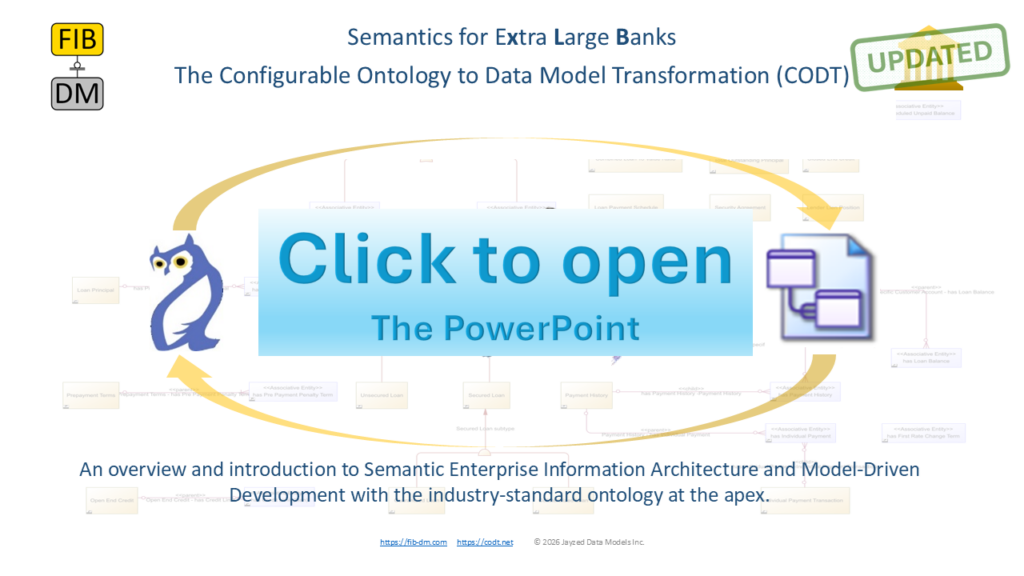
I recommend watching the video first and then downloading a PDF of the PowerPoint for your reference. The video demos the screenshots in PowerDesigner and MS Excel; the voiceover has twice the word count because it explains the diagrams.
The text of the Presentation
Semantics for Extra Large Banks
The Configurable Ontology to Data Model Transformation (CODT)
An overview and introduction to Semantic Enterprise Information Architecture and Model-Driven Development with the industry-standard ontology at the apex.
https://fib-dm.com
https://codt.net
Your institution embraces RDF/OWL and the FIBO
You have, or are moving towards, a Semantic Technologies Center of Excellence (COE) and RDF (Triple) Stores.
You use and support the development of the industry-standard ontology.
You have licensed or downloaded and evaluated the FIBO data model.
The CODT Patent (US12038939) enables full disclosure of the transformation technology.`
F Finance key point 2
Semantic Center of Excellence (CoE) challenges
Many global banks already implemented, extended, and customized the industry-standard ontology.
They have highly qualified ontologists and data scientists.
However, 95% of the bank’s systems rely on relational databases, using data models.
Data Architects have the FIBO Data Model but can’t leverage their colleagues’ work in the Semantic COE.
The risk is that Semantic implementations become yet another data silo, using a different language from the rest of the organization and impeding integration.
F Finance key point 3
FIB-DM and CODT are the bridge across the chasm.
The Industry Standard is available in your Data Modeling tool.
F Finance key point 4
The Vision: Semantic Enterprise Information Architecture (SEIA)
Use Type FIB-CM RDF FIBO OWL Level
Business Conceptual
FIB-DM
FIB-UM Enterprise
Design Logical
Data Model
Department
Physical
Development RDBMS
Implementation
RDF Project
Data Message Process Object
F Finance key point 5
Bi-directional model transformation enables SEIA
We generate data models from industry/domain and our proprietary ontologies. Design conceptual models in RDF/OWL.
FIBO
Industry
In-house
We reverse-engineer our data models to extend the enterprise and project ontologies.
FIB-DM
Enterprise
Project
Ontologist 6
FIB-DM training
You should have completed Semantics for Managers, Project Architects, and Finance Users with the 15 Concepts.
The Education path shows 3 lessons for midsize, large, or very large banks. The classes are fully applicable to all Financial Institutions.
- “Midsize banks” means no Semantic Technologies yet.
- “Large Banks” has an Open Banking example.
- “Extra Large Banks” have to plan to customize the FIBO.
Every bank is different.
In practice, we cover all three lessons and move faster when content repeats or is not critical.
F Finance key point 7
Asset size is a poor proxy for semantic sophistication
Semantics for Data Architects, the name of the first FIB-DM education resource, became a catchphrase.
The first part of this lesson is a shorter dive into the data model.
FIB-DM on the EDMC website was for financial institutions with less than $200 billion in assets; hence, “Semantics for Midsize Banks.”
However, some financial institutions, such as hedge funds, for example, are very advanced. Many banks on FIB-DM are now building out ontology capabilities.
The second part of this presentation is an overview of the transformation technology.
CODT is for Financial Institutions that use and extend FIBO; many, but not all, are very large banks.
F Finance key point 8
Intended Audience & POC Team
Finance, management, or business stakeholder who has a working knowledge of Entity-Relationship and Ontology diagrams. You are authorized to sign non-disclosure and license agreements.
Ontologist with an in-depth understanding of the FIBO and in-house ontologies. You want to spread adaptation across your enterprise. You are well-versed in RDF/OWL and SPARQL.
Data Architect, with experience in Enterprise Reference models. You evaluated and want the industry-standard, FIB-DM. You are an expert in your Data Modeling Tool and its import functionality.
Developer / MS-Excel Power User experienced in VBA, Power Query, and the M-Language.
F Finance key point 9
Inventor and Presenter
Jurgen Ziemer has 20 years of industry experience as a data architect and ontologist at leading Financial Institutions and service providers.
Jayzed Data Models
Accenture
Seven years as an IBM Software Group Consultant for the Banking and Financial Markets Data Warehouse (BFMDW) model at 45 banks in North America, Europe, and Asia.
Implementing BFMDW at Citi and Deutsche Bank.
Contributor, reviewer, and speaker at FIBO conferences
IBM Credit Suisse
Deutsche Bank
Jayzed Data Models Inc. is a US consulting company incorporated in 1999.
Jayzed holds the FIB-DM copyrights and is the designated assignee of the CODT Patent.
Citi
Reuters
German Stock Exchange
F Finance key point 10
EDMC and OMG collaborate closely
EDM Association is the member-driven trade association dedicated to elevating data management and analytics as a strategic business priority. Founded in 2005 as the EDM Council, we provide best practices, standards and education to data and business professionals in our data-driven world. https://edmcouncil.org/about/
The Object Management Group® Standards Development Organization (OMG® SDO) is a global, open membership, non-profit consortium. Our members collaborate to craft technology standards that offer measurable value to a diverse range of vertical industries. https://www.omg.org/
F Finance key point 11
EDM Council and Object Management Group
Global Association of over 200 Financial Institutions (FI).
Data Management
Data Standards. DCAM FIBO
Over 220 member organizations. Standards development (UML, BPML, DDS, SysML) CommonsOntology Library
The Enterprise Data Management Council acquired the Object Management Group (OMG) effective 1 October, 2025, creating the world’s largest non-profit trade standard-setting body for data management.
F Finance key point 12
FIBO and OMG Commons
The Financial Industry Business Ontology (FIBO) defines the sets of things that are of interest in financial business applications and the ways that those things can relate to one another. In this way, FIBO can give meaning to any data (e.g., spreadsheets, relational databases, XML documents) that describes the business of finance. https://edmcouncil.org/financial-industry-business-ontology/
The Commons Ontology Library provides a set of small ontologies designed to provide a useful set of modeling constructs that are reusable in different modeling and data deployment environments with minimal commitments.
Commons
OMG Commons is designed as a foundational or upper ontology, independent of the domain or industry.
The FIBO imports the OMG Commons ontologies, deprecating foundational classes in the Foundation module.
F Finance key point 13
FIBO is more than a Knowledge Graph
The Council and its members correctly decided to define the business conceptual model in the Ontology Web Language (OWL) because of its superior semantics.
FIBO Conceptualization and Relations are fully applicable for lower-semantic taxonomies, concept maps, object-, and data models. FIB-DM is a perfect conceptual data model.
https://fib-dm.com/ontology-class-and-data-model-entity-hierarchy/ https://fib-dm.com/ontology-object-property-data-model-associative-entities/
F Finance key point 14
EDMC support and 3,500 data model downloads
“Many EDM Association members want to leverage the industry standard, but don’t have ontology tooling, databases, and the human expertise in-house yet.” (https://spec.edmcouncil.org/fibo/FIB-DM)
With FIB-DM, Data Architects no longer manually transcribe ontology graphs and copy and paste definitions. 3,500 users downloaded the Open-Source version of the FIBO Data Model.
However, even with FIB-DM, Architects at larger Financial Institutions must still manually c&p their FIBO customizations and extensions.
F Finance key point 15
The FIBO is superior to vendor data models
Almost six hundred years ago, Robert II d’Uzès proclaimed Charles VII King of France. Yet the “Involved Party” remains an ultimate supertype across numerous reference models and databases.
OMG Commons breaks the comingled entity into two fundamental concepts:
Agent (person or legal entity)
Role (customer, counterparty, borrower, employee …). One Agent, many Roles
Data Architect 16
The 15 concepts name, icon, and abbreviation
SIT Situation
R D Role Designation
CST Constituent
COL Collection
The Fundamental Concepts model the business of financial services.
These are the top-level ontology classes, defined in OMG Commons.
A ASP Agent Aspect
SP Specification
ARR Arrangement
M Measure
And ultimate supertypes in the data model.
OCC Occurrence
TE Temporal Entity
DOC Document
SQ Scalar Quantity
ACT Account
90% of FIB-DM entities are subtypes of a concept entity
F Finance user key point 17
Ontology-derived Data Model
Ontology graph Transformation/mapping
Class to Entity
Subclass to Inheritance (subtype)
Conceptual Data Model
DepositoryInstitution
Depository Institution subtype
Bank Object Property to Associative Entity
<> provides
Bank Account
<> identifies
Class Restrictions, domain and range
determine Relationships and cardinalities Bank Account Identifier
CODT patent drawing FIG.1 System (removed numerals and added colors)
Data Architect Ontologist 18
Current tooling imports are not fit for purpose
Data Modeling tools, such as Sparx EA and IBM IDA, have rudimentary import capabilities for RDF/OWL files. The imports are a one-click black box with no options or diagnostics.
URIs as entity names
Datatype properties become classes
Class restrictions become anonymous pseudo-classes
No import of annotation properties
Data Architect Ontologist 19
The parsing approach is not scalable
Traditional transformations parse ontology files. They encounter elements of the ontology and create elements of the data model while processing the source files. The parsing approach reaches its limits with very large ontologies like the FIBO.
By default, ontology object properties transform into data model relationships. This transformation loses Metadata for object properties with particular design patterns.
Some large Financial Institution developed rudimentary transformations.
Compare FIB-DM with vendor or in-house FIBO transformations and see the difference!
License the technology that created the industry-standard rather than DIY!
Data Architect Ontologist 20
Outcome of the transformation: Package Properties
The Package Name is the rightmost string in the ontology namespace.
CODT transforms the ontology prefix into the unique code of the package.
Note: All ontology classes, properties with the prefix fibo-fnd-agr-agrbecome model objects of the Agreements package.
The URI is the Uniform Resource Identifier of the ontology. It is a traceability link to the source of the model object.
The second part of this overview shows how CODT extracts properties, transforms and add them to the data model.
Data Architect Ontologist 21
Package Documentation
Package annotations derive from FIBO / OMG ontology annotation properties.
The CODT table shows annotation properties and the number of ontologies (i.e., FIB-DM packages) with documentation.
annotation_property Count dcterms:license 191 rdfs:label 191 skos:changeNote 182 dcterms:abstract 179 cmns-av:copyright 179 fibo-fnd-utl-av:hasMaturityLevel 155 dcterms:contributor 22 skos:note 15 rdfs:seeAlso 14 sm:contentLanguage 12 sm:copyright 12 skos:scopeNote 12 sm:filename 12 sm:fileAbbreviation 11 dcterms:issued 9 sm:fileAbstract 8
We see that most packages have a label.
OMG Commons Parties & Situations also provides the contributors with a note.
License, change note, copyright, and maturity level are on the Lineage tab.
Data Architect Ontologist 22
Package Lineage
The ontology namespace provides the Resource Name of the data model package, which is configured as a prefix for all entities in the package.
All OMG Commons packages have an abstract.
The copyright box lists the Jayzed FIB-DM copyright and all copyright notices in the source ontology.
The depicted data model license for the full commercial version is your IPLA. The open-source version is licensed under the GPL 3.0. The ontologies are licensed under the MIT open-source License (scroll down).
https://jayzed.com/license-agreement/ https://opensource.org/licenses/GPL-3.0 https://opensource.org/licenses/MIT
The open-source licenses and the Jayzed IPLA require that all derived works include the license and copyright notices.
In other words, please make sure to include the notes in your FIB-DM migrations to other tools, generated logical, physical, object models, and all metadata extracts.
Data Architect Ontologist 23
Entity properties
The Name is the ontology class Localname, converted from Camel Case to LDM naming convention (capitalized with space between words).
The Code transforms from the ontology class Prefix: Localname.
The Comment populates from the class annotation RDFS comment and SKOS definition.
There are two particular tabs for ontology-derived data models, Annotations and Lineage.
Data Architect Ontologist 24
Entity annotations
FIBO has extensive documentation captured in annotation properties.
The chart shows the number of classes with annotated documentation.
Count
130113 1 owl:Class rdfs:label
9
1
513 1618 owl:Class skos:definition
782
owl:Class fibo-fnd-utl-av:adaptedFrom
owl:Class fibo-fnd-utl-av:explanatoryNote
owl:Class fibo-fnd-utl-981 av:abbreviation
1615 owl:Class fibo-fnd-utl-av:synonym
Data Architect Ontologist 25
Entity lineage
The Lineage tab captures ontology metadata of the source class. The extended attributes provide traceability into the ontology and preserve semantics beyond the entity-relationship model.
The Resource Name is class Prefix and Localname. FIB-DM uses the resource name as the entity code, but you can generate your codes in the modeling tool.
The Localname is the rightmost string in the Resource Name and URI.
The Prefix is an abbreviation of the URI defined in the ontology.
The Uniform Resource Identifier of the class is a link to the FIBO source ontology.
Restriction and Equivalent class axioms formulate OWL semantics.
Data Architect 26
Complex FIBO patterns (e.g. sub-properties) …
Data Architect 27
Require a sophisticated data model transformation
See the article on issues resolved for many-to-many relationships, closure axioms, hierarchies, incomplete, and inverse object properties. (https://fib-dm.com/ontology-object-property-data-model-associative-entities/)
Data Architect 28
FIBO, vendor, and in-house models for SEIA
We adhere to the industry-standard
Normative
FIBO Production
scope
Enterprise Data Model
Informative
FIBO Customization
Inhouse models
Other Standards
Vendor models
We consult other models
Our goal is leverage
derive
Implementation Department
Project Application
Our method is to derive
Data Architect 29
DAs, merge in your vendor and in-house models
Agreement
Agreement subtype
Contract
Contract subtype
Written Contract Credit Agreement
Written Contract subtype
Financial Instrument
Financial Instrument subtype
Security
Security subtype
Your vendor model has excellent value. Keep it and harvest the content!
Adhere to the industry-standard 15 concepts and their subtype hierarchies
Adopt the FIBO/FIB-DM names and definitions
Identify indirect entity matches, synonyms
Identify direct entity matches, beware of homonyms Robert’s advice 3. Merge entities that are not already in FIB-DM,
identify the appropriate supertype.
Merge attributes from your vendor model.
Equity Instrument Tradable Debt Instrument Note that the FIBO Data Model correctly defines Financial Instruments as a subtype of the Contract, an Agreement – not a Product as some Vendor model do.
Data Architect 30
The concept maps, FIB-CM, link to the data model.
Legal Entity
Identifier
identifies
Monetary has Issued Capital Amount
Country
has Country
has Legal Address
Stock Corporation
Plays Role
Physical Address
Registration registers Authority
Depository Institution
Is registered In
FDIC Certificate Number
FDIC Registry Entry
https://fib-dm.com/semantics-for-finance-users/
Data Architect 31
Ontology and Data Model in sync
MonetaryAmount LegalEntity
MonetaryAmount subtype LegalEntitysubtype
<>
has Issued Capital-MonetaryAmount
has Country-Country
<>
<> has Country LegalEntity- has LegalAddress
<>
Physical Address – has Country
(D)
Beyond owl:ObjectProperty range and domain, the ontology transformation infers data model relationships from class restrictions (here, OMG Commons Legal Entity)
Balance
<>
has Issued Capital Corporation
has LegalAddress
Physical Address
Corporationsubtype Physical Address subtype
Stock Corporation- has Issued Capital
<>
has LegalAddress -ConventionalStreet Address
(D) Stock Corporation ConventionalStreet Address
Data Architect 32
FIB-DM General Public 3.0 vs. Customer License
Topic
FIBO Release
Domain Distribution
Number of Entities
Resources
Detail
Original FIB-DM
Your FIB-DM derived works
Foundation
Business Entities
Finance, Business & Commerce
Securities Derivatives
Indexes & Indicators
LOANS
Funds
Corporate Actions Market Data Business Processes
PowerPoints
Videos
Whitepapers
Your current General Public License 3.0
2018/Q4 Public encouraged
Open Source
1029
X X X
X
X X X X
Your upgrade Jayzed Customer License
2025/Q4 Private prohibited
Private, not applicable
3,173
Open Source license requires you, to copyleft, that is to license your derived models to the public.
With a commercial license, you keep FIB-DM extensions private.
Likewise, for the public, all Education materials are subject to copyright
With a commercial license, you
are free to modify, translate, edit, and even lift off images and diagrams as long as they remain within your organization.
F Finance key point 33
Financial Industry Business Data Model – summary
- Most comprehensive Enterprise Reference model with 3,173 entities
- Superior Design of a Semantic Data Model
- Extensive documentation of the industry-standard ontology • Full lineage to the ontology
- Semantic Enterprise Information Architecture
- Same names, definitions, and design patterns across the enterprise
- The ontology at the apex includes business-friendly concept maps, derived data, and object models.
- Unifies semantic and conventional data management
F Finance key point 34
Transparency for your FIB-DM evaluation
Explore the PowerDesigner Model
Semantics for Data Architects Study the Education resources
Examine the 2025/Q4 Full Model content
Review license, maintenance, and pricing
F Finance key point 35
Version 1.0 Atlantic: CODT meets MS-PowerQuery
MS-Excel, PowerQuery, and the M-language
Data Architect Ontologist 36
The way: Semantic Model-Driven Development (SMMD)
FIBO RDF OWL FIB-DM Data Model
Configurable Ontology to Data-model Transformation
Semantic Triple Store Relational Database
F Finance key point 37
Atlantic is the way to Semantic EIA and MDD
2025/Q4
Full
release
3,173 entities
The world’s largest data model.
Configurable Ontology to Data model Transformation (CODT)
F Finance key point 38
The patented technology that created the FIBO Data Model
The old OWL file-parsing-approach doesn’t produce usable data models. It can’t cope with very large ontologies.
The new ETL approach creates high-quality models. The technology is fully scalable and configurable.
Metadata Sets (MDS) are keyed records that hold properties for all objects in a model.
Ontology metadata sets hold the record extracted from the ontology platform • Entity-Relationship metadata sets transform ontology into ER.
PowerDesigner (or another tool) metadata sets are ready to load into the data modeling tool.
Data Architect Ontologist 39
Metadata sets are the novel approach.
Metadata Sets are metadata stored in data sets.
Similar to system tables on a relational database, CODT metadata sets are isomorphic representations of ontology, entity-relationship, and data modeling tool-specific metadata.
The transformation is a two-step process:
Transform Ontology Metadata into generic Entity-Relationship metadata
Transform the Generic ER into tool-specific metadata.
The same generic ER Metadata Set is the source for both PowerDesigner and Sparx EA metadata sets.
Data Architect Ontologist 40
System overview
Microsoft Excel is the tool of choice to view and analyze tabular data, and every data architect has Excel and knows how to use it.
Hence, MS-Excel is not only a fast prototyping tool for the CODT Metadata Sets but also makes the transformation easy to deploy.
Component Extraction Transformation
Load
Metadata Set Ontology Metadata Generic ER Metadata
PowerDesigner
Excel Workbook Ontology MDS.xlsx
Entity Relationship MDS.xlsx
PowerDesigner MDS.xlsx
Any platform and programming language can implement the system, metadata sets, and method. CODT patent drawing FIG.2, System (in color, numerals removed for clarity)
Data Architect Ontologist 41
Ontology class to data model entity – a journey
\Data Architect Ontologist 42
Extraction with SPARQL queries
Owl Classes.rq
SELECT ?class ?qname ?namespace ?skos_definition WHERE {
?class a owl:Class . BIND(afn:namespace(?class) AS ?namespace) . FILTER (smf:isBound(?namespace) ).
BIND (smf:qname(?class) AS ?qname ) .
OPTIONAL { ?class skos:definition ?skos_definition} FILTER (?class NOT IN (owl:Nothing, owl:Thing))
}
The SPARQL query selects Class, qualified name, namespace, and definition, filtering out unnamed classes.
The result set is a CSV file..
Ontologist 43
Extraction: CSV result set into Ontology MDS
The ontology metadata workbook imports the raw extract and performs simple format conversions from the raw result set.
We have the Class, Qualified Name, Namespace, the CODT configured main descriptive annotation property, Prefix, Localname, and FIBO URI. Other Excel tabs, ontology metadata sets for Object Properties, Domain, Range, Sub-class, and Sub-property.
Data Architect Ontologist 44
Excel Power Queries extract into the MDS
Get Data opens Excel Power Query Ribbon.
The Metadata Sets are self-populating – every worksheet has query.
We can refresh (=load) individual or all metadata sets.
The Queries & Connections pane shows the load status (any errors) and the number of records in the MDS.
Data Architect Ontologist 45
Transparent transformation rules
Metadata preview
Transformation rules
Data Architect Ontologist 46
4GL Query and transformation language
The data source is the raw SPARQL query result set.
Data Architect Ontologist 47
Transformation (1): Entity-Relationship MDS
Entity Code is the Class QName
A VBA function transforms the Localname into an The URI of the FIBO class entity name per the naming convention:
=UnCamel([@Localname])
A Power Query with the Ontology MDS as its source populates metadata.
Data Architect Ontologist 48
Transformation (2): Tool-specific MDS
The second transformation step converts the generic Entity-Relationship into a data modeling tool-specific metadata set. In this case, PowerDesigner can directly import this MDS.
For entities, the transformation is a simple copy of the Entity-Relationship MDS.
Data Architect 49
Load: The data modeling tool imports the MDS
There are 25 MDS for PowerDesigner Excel imports
MDS columns map to metamodel objects
Data Architect 50
Stacked queries and ETL master the complexity
Intermediate MDS
Interface MDS
Data Architect Ontologist 51
CODT Excel Power Query Statistics
The MDS folder contains queries that provide the interface to metadata sets for the next transformation step.
MS Excel Worsheets Power Queries Ontology MDS 36 44 Entity Relationship MDS 80 84 PowerDesigner MDS 26 30
Total 142 158
SPARQL queries 18
PowerDesigner Excel imports 25
CODT is a white box, an open book. The Excel version software fully discloses all worksheets, queries, and VBA code.
New users and operators can generate with a single click, using default configuration settings.
As a Data Architect, you use CODT as an ETL and development platform, diagnosing results and tweaking transformation rules for your modeling and naming standards.
VBA developers may secure the data sheets, fully automate Extract and Load, or port the application to the ETL environment.
Data Architect 52
CODT Embodiments
The CODT license includes the Patent Rights right to use protected intellectual property, metadata sets, and algorithms. For full production SEIA, you can automate interfaces and encode the patented embodiments below.
Implementation Embodiments
Ontology Source Transformation System Data Model
Type
Ontology platform
RDF/OWL files
Subtype
Development Platform
RDF Store, Semantic Endpoint
Local
World Wide Web
Extraction
SPARQL
Parser
OS
MS Windows
Unix
Application type
MS-Excel
ETL Program
User Interface
White Box
Guided
Data Model Type
Conceptual
Logical
Physical Object
Modeling Tool
Power Designer
Sparx EA
Other
Tool Interface
Import
API
CODT patent Table 14, Embodiments (color added for clarity)
Create a connection to your RDF Store and run the queries in a batch.
Move CODT server-side.
Transform with your ETL tooling rather than M, and store MDS on your RDBMS.
Create a UI for operators and configuration wizards
Generate other models
Load directly using your data modeling tool or repository API
F Finance key point 53
Reverse mode embodiment, claims 10 & 16
The CODT Metadata Sets are bi-directional.
CODT can reverse-engineer ontologies from Data Models!
RDF OWL
Extract Transform Load
The Data Modeling generates List Reports matching the Data Modeling tool-specific MDS.
The Power Query populates the Metadata sets, performing basic data cleansing.
The Tool-specific MDS populates the Entity-Relationship Metadata Sets.
The Ontology MDS populates from the Entity-Relationship MDS.
Power Queries and formulas break the data set down into triples.
We load in triples into the ontology platform, using SPARQL CONSTRUCT or bulk insert.
F Finance key point 54
Reverse example: Extract from PowerDesigner
Our example is Logical Data Model created from the New York Stock Exchange’s OpenMAMA messaging API.
The PowerDesigner Entity list report has Code, Name, and Comment. The PowerDesigner MDS sources the list report
Data Architect 55
Transform in the Entity-Relationship MDS
The Metadata Set populates from the PowerDesigner Entity MDS
Prefix and URI are configuration settings matching the designated prefix and namespace of the ontology
The Entity Name transforms to Localname with a Camel Code string function
The Resource Name is a concatenation of Prefix, delimiter, and Localname
F Finance key point 56
Load into ontology
A query populates the Class metadata set from the Entity MDS
Triple, “T_” metadata sets break down the class record into subject, predicate, and object.
Data Architect 57
The triple match the SPARQL SELECT joins
subject predicate object fib-omds:Auction rdf:type owl:Class fib-omds:OrderBook rdf:type owl:Class fib-omds:Quote rdf:type owl:Class fib-omds:Referential rdf:type owl:Class fib-omds:SecurityStatus rdf:type owl:Class fib-omds:Trade rdf:type owl:Class
SELECT ?class ?qname ?namespace ?skos_definition
WHERE {
?class a owl:Class .
OPTIONAL {
?class skos:definition ?skos_definition}
subject predicate skos_definition
Data disseminated during the auction period, i.e. the period of time when there is no automatic execution
on an order book. This also includes indicative data and, where relevant, imbalance data sent during the
skos:definitio process that matches orders at the end of an auction and determines fib-omds:Auction n the final auction price
skos:definitio Represents the state of the order book. fib-omds:OrderBook n
The most current bid or ask prices and quantities at which the instruments can be bought or sold. The bid
quote shows the price and quantity at which a current buyer is willing to purchase the instruments, while
skos:definitio the ask shows what a current participant is willing to sell the fib-omds:Quote n instruments for.
Represents standing data such as symbol, commodity, and exchange information and any pertinent
information about the contract terms. Prior trading period closing/settlement prices can also be
skos:definitio disseminated in this event type. Typically this represents static data. fib-omds:Referential n
Data that indicates the current market trading condition of an individual security, for example, if trading in
the security is suspended. This identifies phase transitions in the fib- skos:definitio venue’s market model.
omds:SecurityStatus n
skos:definitio Information that belongs to a transaction that involves the selling and fib-omds:Trade n purchasing of a tradable instrument
Ontologist 58
Assert the triple in the Ontology Platform
Definitions
Loaded Classes
SPARQL CONSTRUCT
Ontologist 59
US Patent & Trademark Office publication
With 23 drawings, 19 tables, and 35 pages of specification, the patent fully discloses the invention. https://codt.net/patent/
16 Claims comprehensively cover the method, system, non-transitory storage medium, and all embodiments.
The patent protects CODT licensees and generated models, including FIB-DM.
F Finance key point 60
License Agreement
FIB-DM licensees can purchase CODT as an add-on.
New users can license the FIB-DM + CODT bundle.
Software deliverables are the MS-Excel CODT Workbooks.
The site license doesn’t limit the number of users.
(There is no standalone CODT license.)
Jayzed already holds the copyright to the FIBO Data Model.
You are free to modify the software and to create new models for internal use.
Just like your FIB-DM license, you must keep derived models confidential.
• Educational resources are included. • The license covers the intellectual property.
You are free to modify, translate, edit, and even lift off images and diagrams as long as they remain within your organization.
You are free to leverage metadata sets, queries, formulas and algorithms disclosed in source code, and the specification for internal development.
You must not share CODT embodiments.
F Finance key point 61
Pricing
Licenses are priced for institution size, using your EDM Council membership tier as a segment.
Line of Business Sell Side
Buy Side
Custody
Metric
Consolidated Capital
Assets under Management
Assets under Custody
Tier A $10B+
$200B+
$1,000B+
Tier B Tier C $500M-$10B <$500M
$50B-$200B <$50B
$100B-$1,000B <$100B
https://fib-dm.com/full-data-model-upgrade/
The add-on price for existing FIB-DM licensees is two-thirds of the price of your data model license, around $40,000 for a Tier B bank. The bundle price for new users is 1.5 times the standalone FIB-DM.
Central Banks, Multilateral Lenders, and other qualifying financial institutions get the Tier C price irrespective of asset size.
F Finance key point 62
Proof of Concept (POC) – overview
The Proof of Concept is an offer to try, test, and evaluate CODT
Scope
Objective
Materials
Training & Support
SEIA is a significant enterprise transformation.
FIB-DM already proves that CODT creates the superior data model.
To prove that CODT works for your FIBO extensions. Test the application
Evaluate the Intellectual Property MS-Excel Workbooks
Education materials
Patent (for Legal and Compliance to assess) Two Days Training (online video conference)
Three Days support (emails and calls)
F Finance key point 63
Assemble your Proof of Concept Team
Management, Finance, or business sponsor. You are authorized to sign non-disclosure and license agreements.
Ontologist with an in-depth understanding of the FIBO and in-house ontologies. You adapt the queries to your SPARQL dialect and produce the raw ontology metadata .
Data Architect, with experience in Enterprise Reference models. You configure CODT to match your naming standards, and load metadata sets into the data modeling tool
Developer / MS-Excel Power User experienced in VBA, Power Query, and the M-Language. You can troubleshoot complex formulas and queries, and explore technical embodiments.
F Finance key point 64
Proof of Concept – technical preparation
Power PC (32 GB Ram), Windows 11 (64-bit), MS Excel, and MS PowerQuery
Ontology Platform with SPARQL Query User interface: Topbraid Composer, Protégé, or RDF-Store/Semantic Endpoint.
SAP PowerDesigner (PD) data modeling tool. If you have ERWin or other modeling tools, use PD trial first and import the data model. Later, you may customize CODT to import into your tool.
The FIBO is loaded in your Ontology Platform. Before the POC, try the Entity Query and reproduce the raw metadata extract.
Your proprietary ontology should be an extension of the FIBO. Make sure to include FIBO modules and to define a prefix for your namespaces.
E.g.: @prefix br-bank-model: http://bankontology.com/br/Bank_model.ttl# • The Entity Query must return FIBO alongside your classes with a prefix.
Data Architect Ontologist 65
Proof of Concept typical six-week timeline
ID Task Name
1 CODT POC
2 Preparation
3 Lick-off
4 Hands-on training
5 Entity end-to-end
6 Associations
7 Data Property
8 Packages
Start
Two weeks are for introduction into CODT and transforming the FIBO as a POC.
9 Annotations
10 Transform FIBO
11 Extract Ontology Metadata
12 Transform E/R Metadata
13 Load into DM tool
14 Transform Your Extensions
15 Explore Configurations
16 Explore embodiments
17 Wrap-up
18 POC Complete
We repeat the transformation exercise, adding your proprietary ontologies.
You can explore configuration changes and other embodiments
F Finance key point 66
Next step: Discuss a CODT POC
Find further resources on the FIB-DM and CODT websites and the YouTube Education Channel.
Send an email to jziemer@jayzed.com to schedule an overview and discussion with your Q&A.
https://fib-dm.com/ https://codt.net/ https://www.youtube.com/c/fibdm
F Finance key point 67
Summary and conclusion
The Semantic COE must not become another silo.
The FIBO is the industry standard.
CODT leverages the ontology for Data Management
Our vision is Semantic Enterprise Information Architecture (SEIA).
FIB-DM is the superior industry-standard Data Model.
Copyrights and Patents protect your investment.
F Finance key point 68